Winter 2009
Cooking Classes
|
REGISTRATION
IS OPENfor
WINTER 2009 COOKING CLASSES
Online,
In-Person, or by Telephone
Harper's Point classes - Call
513-489-6400 Settler's Walk classes - Call
937-748-4540
www.cookswaresonline.com
To
view the full schedule and all of the details, visit our website now
and plan some fun this winter! Limited seating -- Plan early,
then Register!
Upcoming
January Classes: (View Feb, Mar, and Apr classes at our
website).
Thu, Jan 22 -
Dinner Tonight - Pasta! with Courtney Rathweg
Harper's
Point from 6:30 - 9:00pm. $40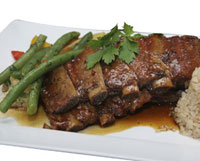
Thu, Jan 22 -
Cooking for the Week - Creative Casseroles with
Sean Schmidt
Settlers' Walk from 6:30 -
9:00pm. $45
Sat, Jan 24 -
Be Your Guest - Chicken Tonight with Leigh Ochs
Harper's
Point from 11:00am - 1:30pm. $45
Tue, Jan 27 -
The Whole Grain Story with Lori Cole
Harper's
Point from 6:30 - 9:00pm. $40
Tue, Jan 27 -
Fabulous Flavor from Slow Cooker with Nancy Pigg
Settlers'
Walk from 6:30 - 9:00pm. $40
Wed, Jan 28 -
Fabulous Flavor from
Slow Cooker with Nancy Pigg 
Harper's Point from 6:30 -
9:00pm. $40
Thu, Jan 29 -
"The Best" German Favorites with George
Stengl
Harper's
Point from 6:30 - 9:00pm. $45 - Sold
out!
Thu, Jan 29 -
Slow and Easy - The Basics of Braising with Gabe
Gardner
Settlers' Walk from 6:30 -9:00pm.
$40
Mon, Feb 2 - "Braise Worthy" Dinner Party with Jackson Rouse
Harper's
Point from 6:30 - 9:00pm. $50
Mon, Feb 2 - Savona Ristorante with Keith Taylor
Settlers' Walk from
6:30 - 9:00pm. $45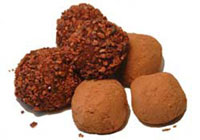
Wed, Feb 4 - Mushroom Masterpieces with Dan Berger
Harper's Point from
6:30 - 9:00pm. $40
Sat, Feb 7 - Phyllo and Puff Pastry with Rhonda Clark
Harper's Point from
11:00am - 1:30pm. $40 - Partial
Hands-On!
Sat, Feb 7 - Love at First Bite - Chocolate Workshop with Beth
Klosterboer
Settlers' Walk from 11:00am -
2:00pm. $60 - Hands-On!
3 Ways to Register: On-Line, In Store,
or by Phone
Harper's
Point classes - Call 513-489-6400
Settlers'
Walk classes - Call 937-748-4540 www.cookswaresonline.com
10%
Discount on merchandise purchases on the day you attend
class!
(excluding kitchen
electrics). |
You Thought
You Knew Chili . . .
|
If all you know
about chili is what your mother made, or perhaps what you get from a
can, you're ready to be educated. If you are a chili elitist
and have definitive opinions, well, we're here to urge you to keep
an open mind and further expand your horizons.
 Regional Flair -
Versions of chili vary greatly from region to region of the
country. The origins of chili as a "poor man's stew" explain a
lot about the root of so many variations. People used what was at
hand to build their pot of warmth. If you had ready access to
meat, that became the focus of your chili. If tomatoes were
handy, they took a predominant role. In this historical
tradition of improvisation, each chili recipe is valid as long as it
has chiles aplenty! Regional Flair -
Versions of chili vary greatly from region to region of the
country. The origins of chili as a "poor man's stew" explain a
lot about the root of so many variations. People used what was at
hand to build their pot of warmth. If you had ready access to
meat, that became the focus of your chili. If tomatoes were
handy, they took a predominant role. In this historical
tradition of improvisation, each chili recipe is valid as long as it
has chiles aplenty!
"A Bowl of Red" from
Texas - Texans spar with every other region for "chili
rights." They lay claim to the dish even designating it as the
official state dish. Texas-style chili puts meat at the center of
its recipe with onions and chiles sharing the stage. Other
ingredients, such as cilantro, salt, or stock might be added, but
certainly no tomatoes, and no beans! As the saying goes
in Texas, "If you know beans about chili, you know there's no
beans."
5-Ways from
Cincinnati - The other, competing epicenter for chili rights
belongs in Southern Ohio. Cincinnati's version of chili is
said to have evolved from a dish concocted by local Greek immigrants
and contains a few more inventive spices, (including allspice,
cloves, cinnamon, and cocoa), and sports less heat than a Texas
chili. But it's not just the chili recipe that distinguishes
Cincinnati chili, it's how it's ordered and served - 5-ways and
notably on top. More on that below.
Louisville
Style - This style of chili lies somewhere between Texas and
Cincinnati on the heat scale and includes spaghetti pasta as an
essential ingredient. The fare is hearty and thick, though
remains only an aspiring wannabe in the national chili
contest.
Vegetarian and Other
Variations - Though a vegetarian chili may be considered an
oxymoron by some, the spices and flavorings of traditional chili
pair so well with beans that a vegetarian version is a
natural. Some excellent vegetarian chilis utilize lentils as
the primary ingredient making it healthy and relatively quick to
make. Experimentation and improvisation have yielded newer
classics in the chili genre; White Chili and Green Chili, (Chili
Verde), are both worthy competitors for taste and satisfaction to
the traditional Reds.
 Chili
Societies - If you're serious about chili, you may choose to
declare yourself an official "chilihead" and join one of two
official chili societies that promote chili while raising charitable
contributions for various causes: (1) Chili Appreciation Society
International, Inc., and (2) The International Chili Society. Both
organizations combine chili with some serious fun and worthy
charities. Chili
Societies - If you're serious about chili, you may choose to
declare yourself an official "chilihead" and join one of two
official chili societies that promote chili while raising charitable
contributions for various causes: (1) Chili Appreciation Society
International, Inc., and (2) The International Chili Society. Both
organizations combine chili with some serious fun and worthy
charities. |
Rustling Up Your Own
Chili
|
In the
improvisational spirit of chili, your own chili is waiting to
happen. If your chili life is in a rut, break out with some
different variations.
 The Chiles - In a review of many
cookbooks and many recipes for chili, the only
thing we found in common in each version was the bountiful presence
of chile peppers in some form. After that, the ingredients range far
and wide: meat, no meat, beans, no beans, tomatoes, no
tomatoes. The Chiles - In a review of many
cookbooks and many recipes for chili, the only
thing we found in common in each version was the bountiful presence
of chile peppers in some form. After that, the ingredients range far
and wide: meat, no meat, beans, no beans, tomatoes, no
tomatoes.
Chiles give chili the spice and heat we've come to
love. The heat sensation from peppers comes from the chemical
capsaicin which is present in different quantities in each type of
pepper. Capsaicin triggers a "pain" message to your brain and
releases a pain-killing endorphin response. No wonder chili
tastes and feels so good!
 The peppers, sweet to hot, will dictate your
chili's character, flavor, and flame quality. Common peppers found
in chili recipes and easily available year-round include: Bell,
Poblano, Pasilla, Jalapeño, Cayenne, Serrano, Habanero, and Scotch
Bonnets. Both fresh and powdered versions of pepper find a
home in chili pots. The peppers, sweet to hot, will dictate your
chili's character, flavor, and flame quality. Common peppers found
in chili recipes and easily available year-round include: Bell,
Poblano, Pasilla, Jalapeño, Cayenne, Serrano, Habanero, and Scotch
Bonnets. Both fresh and powdered versions of pepper find a
home in chili pots.
The
Onion - The second most common ingredient found in chili
recipes is diced onion. Onion adds its unique flavor to the
chili's richness and provides a distinct aromatherapy for the
kitchen's cook. Achieving a quick dice of onion requires a
sharp knife. In fact, the curved surfaces and the slippery
layers of an onion are a good test of a new knife.
The
Meat - True to the origins of chili, it's the perfect
application for less expensive cuts of meat whether beef, pork,
venison, turkey or chicken. Ground or in a small dice, the
meat cooks quickly and is subsequently stewed to
tenderness.
 The
Beans - For those whose chili does have beans, just about any
bean will work well in chili. Kidney beans are perhaps the
most familiar to chili, but pinto beans, black beans, cannellini
beans, Great Northern bean, garbanzo beans . . . they'll all produce
a perfect result. The
Beans - For those whose chili does have beans, just about any
bean will work well in chili. Kidney beans are perhaps the
most familiar to chili, but pinto beans, black beans, cannellini
beans, Great Northern bean, garbanzo beans . . . they'll all produce
a perfect result.
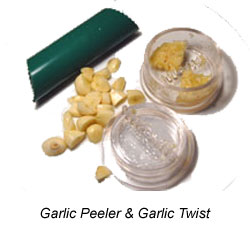
The
Garlic - Garlic is always in order for a good chili.
Peel the garlic in a tubular garlic peeler and mince it finely in a
garlic press or mincer. A new garlic gadget is the garlic
twist. It works easily and has quickly become a favorite garlic tool
of ours.
The Chili
Pot - The key elements of a good chili pot are (1) a large
size, (2) a heavy bottom, and (3) thick-walled sides that
efficiently transfer heat.
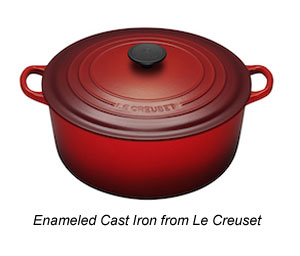 A "Dutch oven" is a traditional pot for
chili-making. A Dutch oven is a large pot (5-7 quarts) with
curved sides, a domed lid and is suitable for the stovetop, oven, or
even an open grill. Dutch ovens were originally part of the
German immigrant kitchens of Pennsylvania. The term "Dutch"
may have nothing to do with the Netherlands, but rather developed
from an American pronunciation of "Deutsch," the German word for
German. Today, Dutch ovens are available in traditional cast
iron, colorful enameled cast iron, and stainless steel
variations. A heavy-bottomed Dutch oven handles the high heat
required in the browning stage, then downshifts easily to the
magical simmering stage. A "Dutch oven" is a traditional pot for
chili-making. A Dutch oven is a large pot (5-7 quarts) with
curved sides, a domed lid and is suitable for the stovetop, oven, or
even an open grill. Dutch ovens were originally part of the
German immigrant kitchens of Pennsylvania. The term "Dutch"
may have nothing to do with the Netherlands, but rather developed
from an American pronunciation of "Deutsch," the German word for
German. Today, Dutch ovens are available in traditional cast
iron, colorful enameled cast iron, and stainless steel
variations. A heavy-bottomed Dutch oven handles the high heat
required in the browning stage, then downshifts easily to the
magical simmering stage.
The Browning
Stage - Each chili recipe begins with the browning of meat
and the sautéing of onions prior to adding other ingredients.
Chili aficionados recommend adding the powdered spices to the
browned meat and allowing the spices to bloom prior to adding any
liquids.
The Art of
Simmering - Chili demands time for the flavors to
develop. Once the ingredients are assembled, a low simmer for
an hour or more is necessary for the spices to re-hydrate, and for
the flavors to become infused throughout the other
ingredients. A chili pot with a heavy bottom and efficient
heat transfer will facilitate a good simmer while reducing the
chances of scorching or
burning.
|
Serving It Up!
|
 A hearty chili is a meal in itself! Serve
it up hot in bowls that have some thickness and ability to retain
heat during the meal. Chili bowls or French Onion soup bowls are the
perfect vessel for insulating the red stew; a soup plate, or a
"flat" bowl shape will cool the chili too quickly. A hearty chili is a meal in itself! Serve
it up hot in bowls that have some thickness and ability to retain
heat during the meal. Chili bowls or French Onion soup bowls are the
perfect vessel for insulating the red stew; a soup plate, or a
"flat" bowl shape will cool the chili too quickly.
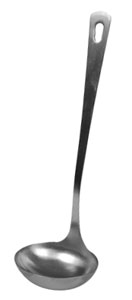
Ladle it
Up! - Ladle your chili directly from the stove pot to
the bowls. We prefer working with both a small ladle and a
large ladle in our kitchen. The small ladle finesses filling
smaller cups or bowls with less mess, and doubles perfectly when
adding liquid to a pot as with risotto. A larger ladle makes
quick work of dishing up the chili with one or two scoops filling
larger bowls.
Garnishing the
Chili - Add some toppings to the chili or offer on the
side:
- Cheese -
Grated cheese melts heavenly on top of a steaming bowl of
chili. Cheddar cheese is a standard pairing with chili, but
Monterey Jack, Colby, or a smoky Provolone would serve equally as
well. Grate your cheese choice in a coarse grate with a flat
grater, box grater, or a Microplane.
- Sour
cream - Chile pepper heat is quelled only by dairy
foods. The capsaicin of the chiles repels water making it
useless in dispelling any excess heat. The casein protein in
dairy foods acts to detach capsaicin molecules from taste buds.
- Scallions -
Equally appealing in color and taste, fresh scallion slices
sprinkled on top of a bowl of chili is also a perfect garnish.
- Saltines -
Some chili diners insist that the only way to enjoy chili is with
a crowd of broken up saltine crackers. Indulge the
traditionalists and have some handy.
Chili as the
Garnish - Use chili as
a hefty topping for other foods:
- Pasta -
Cincinnati-style chili is traditionally served over
spaghetti. Foreigners to Cincinnati may assume some
connection to an Italian Bolognese dish, but it is a dish to its
own claiming Greek and Macedonian heritage. When in
Cincinnati order your chili 2-way for chili and spaghetti, add
cheese and it's a
 3-way, add beans or
onions and it's a 4-way, and all five ingredients and you have
5-way Cincinnati chili. 3-way, add beans or
onions and it's a 4-way, and all five ingredients and you have
5-way Cincinnati chili.
- Hot
dogs - A hot dog in a bun and smothered in chili is a
classic at stadiums and events. Top with a healthy dose of
diced, fresh onions and a cold, cold beer in the other hand and
you're ready to go.
- Steak
fries - Thick oven-fries accept a good chili topping with
ease. Add cheese and you have chili cheese fries.
- Rice - Serve
chili over rice and call it Chili, New Orleans style!
- Tortilla
Chips - Create a variation of a nacho plate with a chili
topping.
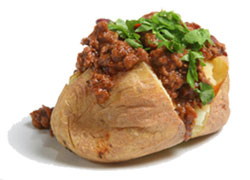
- Baked
Potato - Split a large baked potato, top with chili, add
cheese and onions for a full and filling meal.
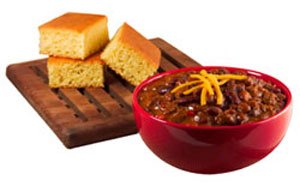
- Cornbread -
Corn is a natural nutritional complement to beans. Hot,
steaming cornbread is a classic Tex-Mex match for a good chili.
|
Smart Chili
Tips
|
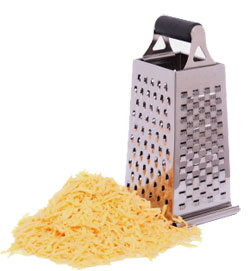 Tip #1: When using a
Microplane to grate cheese, try both methods of grating: (1)
Try holding the cheese firmly and moving the Microplane across its
surface, or (2) Hold the Microplane firmly and move the cheese
across the teeth. Discover which method is easier for
you. Tip #1: When using a
Microplane to grate cheese, try both methods of grating: (1)
Try holding the cheese firmly and moving the Microplane across its
surface, or (2) Hold the Microplane firmly and move the cheese
across the teeth. Discover which method is easier for
you.
Tip
#2: A spritz of oil or nonstick spray on a grater
makes grating cheese easier and clean-up a cinch.
Tip #3: Just about every
chili expert will encourage you to make your chili ahead of time and
let the flavors blend for a day or overnight. Time allows the
flavors to blend and for the ingredients to soak up all of the
spices' power.
 Tip
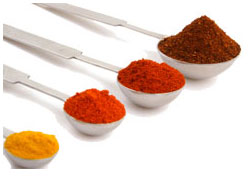
#4: Develop your own secret ingredient for a
signature-style chili. We've heard of some interesting secret
and not-so-secret ingredients including pineapple juice, chorizo
sausage, vinegar, cocoa powder, beer, bacon, Worcestershire sauce,
and garam masala. Fling open the cupboard doors and
experiment! Tip
#4: Develop your own secret ingredient for a
signature-style chili. We've heard of some interesting secret
and not-so-secret ingredients including pineapple juice, chorizo
sausage, vinegar, cocoa powder, beer, bacon, Worcestershire sauce,
and garam masala. Fling open the cupboard doors and
experiment!
Tip
#5: Always use fresh spices for your chili. Last
winter's chili spices won't work for this year's chili. Buy
spices in small enough quantities so they don't expire prior to use.
|
Q & A
|
 Q:
What is chili powder? Q:
What is chili powder?
A: Chili powder is a
generic term for a mix of spices of which the primary ingredient is
some type of powdered chile. Ancho chiles, (dried Poblano
peppers), are a common choice for chili powders. Ancho chiles
have a mild flavor and light heat.  Hot chili powder most likely includes a healthy
dose of cayenne, a hotter chile. Roughly, about one-half teaspoon of
chili powder is equivalent to one chili pod. Chili powder may
contain garlic powder, salt, and other spices. Experiment with
different brands of chili powders and different heat
levels. Hot chili powder most likely includes a healthy
dose of cayenne, a hotter chile. Roughly, about one-half teaspoon of
chili powder is equivalent to one chili pod. Chili powder may
contain garlic powder, salt, and other spices. Experiment with
different brands of chili powders and different heat
levels.
Q: What should
I do if my chili is too thin? Or to thick?
A: Chili, like any good
improvisational dish, may turn out differently each time you make
it. If your chili is too thin, try thickening it with rice,
barley, bread crumbs, or a roux of flour and butter. If the
chili is too thick, thin with stock and adjust
seasonings.
Q: What are
"chipotles in adobo sauce"?
A: Chipotles in adobo sauce
are another common chili ingredient. Chipotles are smoked
jalapeño peppers and adobo sauce is a combination of onions,
tomatoes, garlic, vinegar, salt and other spices. Adobo means
"sauce," 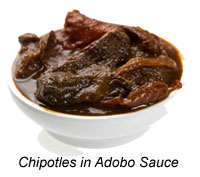 or "marinade" in Spanish. Small
cans of chipotles in adobo sauce are easily found in the ethnic food
sections of supermarkets. Leftover portions of chipotles in
adobo sauce may be stored in the refrigerator. The use of
chipotles in adobo sauce imparts a distinctive smoky heat to
chili. or "marinade" in Spanish. Small
cans of chipotles in adobo sauce are easily found in the ethnic food
sections of supermarkets. Leftover portions of chipotles in
adobo sauce may be stored in the refrigerator. The use of
chipotles in adobo sauce imparts a distinctive smoky heat to
chili.
Q: What is
cumin, another common spice in many chilis?
A: Ground cumin is the
powdered seed of the Cuminum
cyminum plant, a member of the parsley family. With its
unique flavor, cumin imparts a strong warmth to chili and to dishes
of many cuisines. |
Cookbook
Review
|
Killer Chili,
Savory Recipes from North America's Favorite Restaurants by
Stephanie Anderson. Published by Chronicle Books, San
Francisco, CA. Copyright 2007.
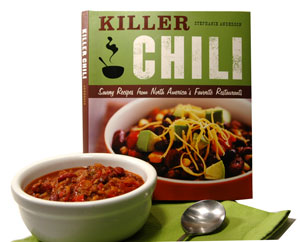 Faithful to the regional nature of chili,
Stephanie Anderson tracks the tradition through five regions of
North America: Northeastern, Midwestern, Southern, Western, and
Canada. Within each region, diners and restaurants that are
famous for their chili are featured. Fifty eating
establishments are highlighted and their own distinctive chili
recipe revealed and recreated for the home cook. The
variations of chili are broad ranging and fascinating reading.
We enjoyed the virtual culinary trip around the continent and have
several recipes marked for trying in addition to the three recipes
below. This book has everything you need to become a
well-rounded
chilihead! Faithful to the regional nature of chili,
Stephanie Anderson tracks the tradition through five regions of
North America: Northeastern, Midwestern, Southern, Western, and
Canada. Within each region, diners and restaurants that are
famous for their chili are featured. Fifty eating
establishments are highlighted and their own distinctive chili
recipe revealed and recreated for the home cook. The
variations of chili are broad ranging and fascinating reading.
We enjoyed the virtual culinary trip around the continent and have
several recipes marked for trying in addition to the three recipes
below. This book has everything you need to become a
well-rounded
chilihead!
|
Chili Recipes
|
Excerpted from Killer Chili,
Savory Recipes from North America's Favorite Restaurants by
Stephanie Anderson. Reprinted with permission of the
publisher: Chronicle Books, San Francisco, CA. Copyright 2007.
All rights reserved.
Beef Chili
with Chipotles & Cilantro
from Clark's Outpost
Barbecue Restaurant
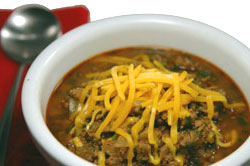 We start with a pure version of chili -
according to Texas' standards. This chili calls for ground
beef, onions and spices. No tomatoes, no beans. The
taste was divine and perfectly accented with the smoky, piquant
taste of chipotles in adobo sauce and a generous helping of
cilantro. Steeping the chili allowed the flavors and spices to
meld nicely. We found it at its best the day after. We start with a pure version of chili -
according to Texas' standards. This chili calls for ground
beef, onions and spices. No tomatoes, no beans. The
taste was divine and perfectly accented with the smoky, piquant
taste of chipotles in adobo sauce and a generous helping of
cilantro. Steeping the chili allowed the flavors and spices to
meld nicely. We found it at its best the day after.
Click
here to view the full
recipe.
Click here for a printable version of
the recipe.
White Turkey
Chili
from Via
Cucina
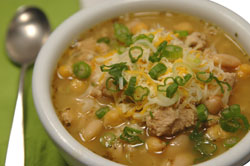 One of the newer chilis on the block, this
White Turkey Chili offers the benefit of a lean, low-fat meat.
While there are no tomatoes in this chili, there are two types of
beans, cannellini beans and chickpeas. We found the taste
outstanding and every bit as satisfying as any red chili. The
heat in this dish came from Tabasco sauce and was easily
customizable for different palates. One of the newer chilis on the block, this
White Turkey Chili offers the benefit of a lean, low-fat meat.
While there are no tomatoes in this chili, there are two types of
beans, cannellini beans and chickpeas. We found the taste
outstanding and every bit as satisfying as any red chili. The
heat in this dish came from Tabasco sauce and was easily
customizable for different palates.
Click here to
view the full
recipe.
Click here for a printable version of
the recipe.
Wild Billy
Chili
from Wild Bill's
Saloon
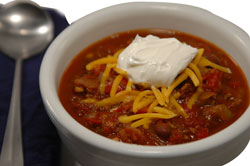 We sometimes think of chili as "cowboy
cuisine." This very Western version of chili has beef,
tomatoes, beans, and . . . a lot of heat! We confess that we
used only 2 tablespoons of crushed red pepper flakes instead of the
full 1/4 cup called for in the recipe. There are a few other
sources of heat in this recipe that make it a powerful stew.
Counterpoint the heat by keeping a few cold beers
handy! We sometimes think of chili as "cowboy
cuisine." This very Western version of chili has beef,
tomatoes, beans, and . . . a lot of heat! We confess that we
used only 2 tablespoons of crushed red pepper flakes instead of the
full 1/4 cup called for in the recipe. There are a few other
sources of heat in this recipe that make it a powerful stew.
Counterpoint the heat by keeping a few cold beers
handy!
Click here to
view the full
recipe.
Click here for a printable version of
the
recipe.
| |




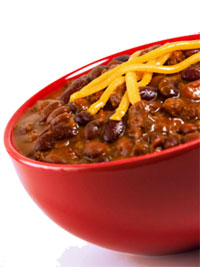 Passions run high when it comes to
chili! Does "real chili" have beans, or no beans?
Tomatoes or no tomatoes? These topics in the chili world
are no mere differences of opinion; words like "sacrilege" and
"heresy" quickly get thrown into the argument! There's
good reason to be passionate about chili! It's
nutritious, budget-friendly, incredibly satisfying, and
frequently a matter of personal and regional pride. The
depths of winter that we're celebrating(?) right now beg for
something warm and filling - chili's your answer! We'll
explore some of the passions and folklore surrounding chili,
set you up with some basics for making your own signature
version, and finally, offer three different chili recipes that
vary widely in character and geographical origin. Fire up the
stove and get ready for some
heat!
Passions run high when it comes to
chili! Does "real chili" have beans, or no beans?
Tomatoes or no tomatoes? These topics in the chili world
are no mere differences of opinion; words like "sacrilege" and
"heresy" quickly get thrown into the argument! There's
good reason to be passionate about chili! It's
nutritious, budget-friendly, incredibly satisfying, and
frequently a matter of personal and regional pride. The
depths of winter that we're celebrating(?) right now beg for
something warm and filling - chili's your answer! We'll
explore some of the passions and folklore surrounding chili,
set you up with some basics for making your own signature
version, and finally, offer three different chili recipes that
vary widely in character and geographical origin. Fire up the
stove and get ready for some
heat!