Next Issue: May 20,
2010
|
"Better
Burgers"
|
|
|
Get Ready for
Summer
|
Every season is a good
season for ice cream and its frozen cousins, but anticipating the
entire summer ahead creates added inspiration. We shift our kitchen
around for the seasons like some rearrange their clothes closets.
The slow cooker slips deeper into the cupboard, and the blender and
ice cream maker slide forward. This spring we're experimenting with
gelato - the intense, Italian-inspired version of ice cream that
raises frozen pleasures to a new level. We like homemade gelato, ice
cream, and other freezes for all of the obvious, cold, refreshing
reasons, but also for its fresh ingredients, no preservatives, no
foreign substances, no guar gum, carageenan, mono- and
di-glycerides, etc., just great personalized taste.
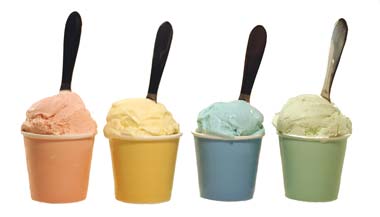
In this issue,
we'll explore summer's sweet frozen options, and equip you with how
to make and serve your own favorites. We finish with a twist on
three classics, vanilla gelato, chocolate sorbet, and strawberry
gelato. Get your
spoons ready!
|
Bridal
Registry
|

Join us
in celebrating the engagements and pending nuptials for the
following couples currently registered at Cook's
Emporium:
Elizabeth Talbert & David Fautsch -
May 22, 2010
Oriana Kaufmann & Mike Dew - June 11,
2010
Erika Takle & Kyle Axeen - June 12, 2010
Anne Dressler & Ben Marsden - June 19,
2010
Emily Mowen &
Andrew Vardeman - June 26, 2010
Megan Neary & Alex Miller - July 17,
2010
Emily Trevillyan &
Chris Malven - July 24, 2010
Samantha L.
Davis & Jeff Hoesing - Sept. 4, 2010
Rachael Cox &
Nicholaus Ohde - October 2, 2010
Access our Gift
Registry on our website!
www.cooksemporiumltd.com
| |
| Frozen Cousins |
Many ice cream terms
get used interchangeably and differently depending where you are in
the world, but there are distinct differences among frozen treats.
We'll begin by answering some key basic questions:
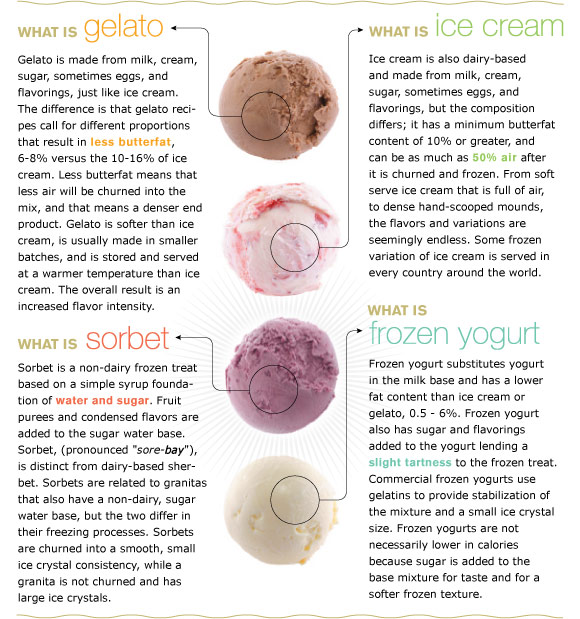
Two
Styles of Ice Cream and Gelato: There are two basic
styles of ice cream and gelato: custard-based or Philadelphia-style.
Custard styles have egg yolks in the base, Philadelphia-styles do
not. Mixtures with eggs must be cooked to a temperature of 185ºF for
food safety purposes, and then thoroughly chilled prior to churning.
Egg yolks serve to stabilize the milk and cream mixture with their
high protein content, and the natural lecithin acts as a butterfat
emulsifier. Philadelphia-style gelati and ice creams skip the egg
yolks and reach the churning step faster with its own style of
richness.
|
| Freezing
Treats |
Freezing your choice
of cold relief is easier than ever! Not long ago, homemade ice cream
involved tons of ice, rock salt, and a sore arm from cranking the
handle. No more! By far the easiest way to make homemade frozen
treats is with a double-insulated, pre-frozen cylinder - a freezer
bowl -- that fits into a holder for churning and produces fresh,
frozen goodness in 20-30 minutes.
 What is churning and why must it
be done? What is churning and why must it
be done?
Churning accomplishes three things during
the gelato and ice cream freezing process:
(1) the chilled mixture becomes
frozen,
(2) air is incorporated into the mix, and
(3) a
smooth consistency of tiny ice crystals is formed.
By
consistently moving the mixture around the freezer bowl, these three
essential things are accomplished transforming sweet liquid into the
best ever food invention. Air is essential for texture and
scoop-ability. Without air, the mixture would be rock hard. The
churning process forms miniscule ice crystals that create a smooth
texture and an optimal mouth feel.
After
Churning
After the ice cream maker has done its
work, the once liquid mixture will be frozen and ready to eat.
However, if you prefer a harder ice cream, remove the frozen treat
from the freezer bowl, place in another container, cover well, and
place in your refrigerator's freezer until ready to
eat.
 How to Choose
the Right Freezer for You How to Choose
the Right Freezer for You
There are many styles of ice
cream makers available. Your choice will be based on preferences and
desired ice cream habits. Think about performance, size, and, most
importantly, ease and convenience!
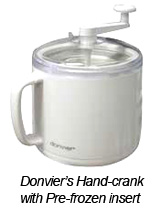
Donvier's Hand-Powered
Ice Cream Maker - This simple unit uses a pre-frozen
freezer bowl and paddle connected to a simple hand-powered crank.
During cranking, a slow, smooth motion will freeze one quart of your
favorite frozen recipe in about 20-30 minutes. (Available as a
special order).
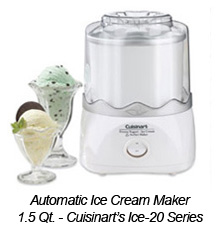 Cuisinart's Automatic ICE-20 Series 1.5
Qt. - This machine is a great entry point for
homemade ice cream, gelato and all kinds of frozen treats. This ice
cream maker also uses a pre-frozen freezer bowl. When ready, the
rotating scraper/blade is powered by a motor that effortlessly moves
the mixture within Cuisinart's Automatic ICE-20 Series 1.5
Qt. - This machine is a great entry point for
homemade ice cream, gelato and all kinds of frozen treats. This ice
cream maker also uses a pre-frozen freezer bowl. When ready, the
rotating scraper/blade is powered by a motor that effortlessly moves
the mixture within 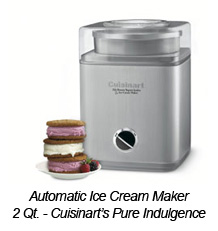 the freezer bowl producing a smooth
consistency. The ice cream maker's top sports a wide pouring spout
that makes adding the mix and any mix-ins easy. the freezer bowl producing a smooth
consistency. The ice cream maker's top sports a wide pouring spout
that makes adding the mix and any mix-ins easy.
Cuisinart's Pure
IndulgenceTM 2 Qt. - This
machine offers a larger 2-quart capacity in a brushed metal housing.
Ice cream is ready in 20-30 minutes. A pre-frozen insert is also
used to bring icy coldness to the process. A heavy duty motor
smoothly churns the mixture making for a smooth, even result. The
lid has a wide spout for accommodating all mixes and mix-ins.
|
| Smart Freezing
Tips |
Tip
#1: For best results, chill the liquid mixture well prior to
freezing. When chilled to refrigerator temperature, 39ºF, it will
have less "distance" to go to a frozen state beginning at around
32ºF and ending at a storing temperature close to 0ºF.
Tip
#2: Match the recipe quantity with the size of your freezer
bowl. The mixture will expand in size as air is incorporated and ice
crystals are formed. Generally, fill the freezer bowl only
two-thirds full. 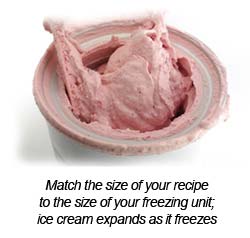 This will allow for expansion space and
churning room. This will allow for expansion space and
churning room.
Tip #3: Frozen foods can dull taste
buds. Make sure that any fruits used are very ripe and flavorful. A
liquid mixture may taste too strong, but will freeze nicely with
great flavor.
Tip #4:
Allow the freezer bowl to be thoroughly chilled prior to churning. A
typical 1-1.5 qt. bowl will take between 6 - 22 hours to become
completely frozen depending on your freezer. Gently shake the bowl
to test its frozen-ness; if you hear liquid sloshing about, more
chilling time is required.
Tip #5: If your gelato or ice cream
uses alcoholic liqueurs, add at the very end of the churning
process. If you are making sorbet, add the alcohol at the beginning
of the freezing process. Alcohol lowers freezing temperatures and
affects how ice crystals are formed in each type of
mixture.
Tip
#6: Buy an extra freezer bowl. Having two freezer bowls
is a dream come true! Two batches can be made quickly in sequence,
or different flavors presented at the same
time.
Tip
#7: Store your frozen ice cream in a separate container than
the freezer bowl. The ice cream will continue to freeze and become
harder. Scooping hardened ice cream may damage the freezer bowl.
Also, ice cream will taste fresher and not take on freezer odors if
stored in an airtight
container.
|
Q & A
|
|
 Q: My homemade ice cream becomes very hard
after a day or two in the freezer. What's wrong? Q: My homemade ice cream becomes very hard
after a day or two in the freezer. What's wrong?
A: Homemade ice cream has less
air incorporated into it than commercial versions; this makes it
harder when thoroughly frozen. Softer treats can be had in several
ways: (1) Add more sugar to the mixture; this inhibits hard
freezing, (2) Store at a warmer temperature, (3) Allow the container
to stand covered on the counter for a few minutes before scooping,
or (4) Microwave the container on half power for 10
seconds.
 Q: What's the best way to scoop ice
cream? Q: What's the best way to scoop ice
cream?
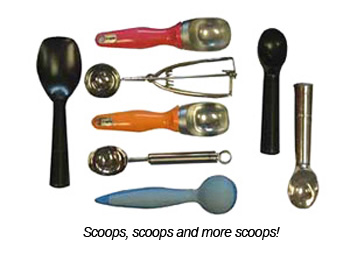
A: Frozen treats can
require some arm muscle to get from container to dish! Regular
flatware spoons will easily bend under the frozen pressure. A great
scoop makes life easier! Choose from many styles of scoops designed
to collect and release any frozen concoction. You'll find insulated
scoops, scoops with a releasing lever, and many other styles. Check
the handle of your scoop - is it comfortable? Long enough for
applying some leverage? We'll be glad to show you our
favorites.
Q: My ice cream
and even my ice have an off flavor. What causes it and how can it be
prevented?
A: Despite the cold of a
freezer, condensation and oxidation can occur on the surfaces of all
frozen foods including plain ice. Both these processes can result in
tastes and odors resident in the freezer (and the refrigerator that
may share air with the freezer), landing and crystallizing on the
food's surface. Tightly wrap all foods to minimize air exposure. For
ice cream, a layer of plastic wrap placed directly on its surface
will help reduce frozen condensation and subsequent freezer odors
and tastes.
Q: The chunks of
fruit in my ice cream become like hard rocks when frozen and eaten.
How can I make them softer and make a better ice cream
texture?
A:
When adding fresh fruit to your frozen concoction, dice or
mince to a small size, then sprinkle the pieces with sugar allowing
them to stand for several minutes. The sugar will draw out excess
water allowing the fruit pieces to remain softer once completely
frozen. Add the macerated fruit to the ice cream mixture only in the
final minutes of freezing.
|
Cookbook Review
|
Making Artisan
Gelato by Torrance Kopfer. Photography by Madeline Polss.
Published by Quarry Books, a member of Quayside Publishing Group,
Beverly, MA. Copyright 2009.
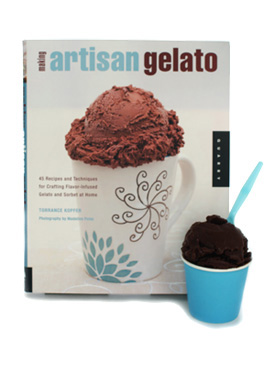 Whether a novice, first time, ice cream maker,
or a practiced churner, this cookbook with its stunning photography
provides basic instruction and advanced inspiration to take you to
the next level. The first part of the book is instructional. Chef
Kopfer guides us through the two basic types of frozen bases -
custard (egg) bases which must be cooked and chilled and
Philadelphia-style, non-cooked bases. (This book gets extra bonus
points for including ingredient weights along with volume
measurements). The focus is on making great gelato, but sorbets and
granitas are equally worthy inclusions. Kopfer articulates the key
points that yield desired success at the end of the process. With
this expert guidance, recipes are offered that range from basic to
exotic with flavor and flair. We started by sampling the basics --
vanilla, chocolate, and strawberry - with the recipes below. Those
now mastered, we have a few enticing concoctions on our list of
flavors to try next: Pistachio Gelato, Blueberry Lavender Gelato,
Candied Ginger Gelato, Pink Grapefruit, and Tarragon Sorbet. Mmmm .
. . . Whether a novice, first time, ice cream maker,
or a practiced churner, this cookbook with its stunning photography
provides basic instruction and advanced inspiration to take you to
the next level. The first part of the book is instructional. Chef
Kopfer guides us through the two basic types of frozen bases -
custard (egg) bases which must be cooked and chilled and
Philadelphia-style, non-cooked bases. (This book gets extra bonus
points for including ingredient weights along with volume
measurements). The focus is on making great gelato, but sorbets and
granitas are equally worthy inclusions. Kopfer articulates the key
points that yield desired success at the end of the process. With
this expert guidance, recipes are offered that range from basic to
exotic with flavor and flair. We started by sampling the basics --
vanilla, chocolate, and strawberry - with the recipes below. Those
now mastered, we have a few enticing concoctions on our list of
flavors to try next: Pistachio Gelato, Blueberry Lavender Gelato,
Candied Ginger Gelato, Pink Grapefruit, and Tarragon Sorbet. Mmmm .
. . .
|
Gelato and Sorbet
Recipes
|
Recipes
excerpted from Making Artisan
Gelato by Torrance Kopfer. Published by Quarry Books, a
member of Quayside Publishing Group, Beverly, MA. Copyright 2009.
Reprinted with permission of the publisher. All rights
reserved.
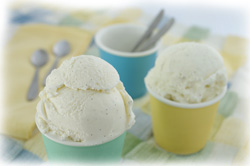 Madagascar Bourbon Vanilla
Gelato Madagascar Bourbon Vanilla
Gelato
View and
Print
Vanilla is a perfect place to
start mastering home-crafted freezes. This recipe is in the
Philadelphia-style tradition of no eggs, no custard-making step.
Rather, the richness comes from a slightly greater reliance on
cream. The vanilla flavor in this version comes from a fragrant
vanilla bean pod steeped in milk. The finished vanilla flavor was
nicely balanced with the sweetened cream.
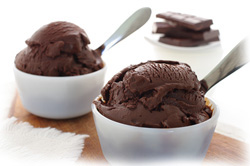 Chocolate Sorbet Chocolate Sorbet
View and
Print
Like all sorbets, this deep chocolate
version is based on a simple sugar and water mix. A double depth of
chocolate is added with cocoa and melted dark chocolate - it's like
a primo fudgsicle. The
mixture freezes easily and forms a perfectly smooth texture. The
result is a satisfying experience that brings new meaning to the
oft-used chocolate phrase, "melts in your mouth...."
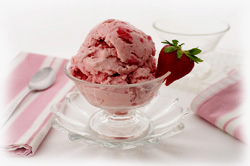 Strawberry Gelato Strawberry Gelato
View and
Print
What better way to celebrate the beginning
of summer than with the very best frozen strawberry concoction you
can imagine. Building on the flavor-burst of ripe, local berries,
this classic pairing with cream generates a seasonal favorite not to
be missed. This recipe demonstrates a cooked custard base - a good
technique to master and become comfortable with in the frozen treat
world.
| |